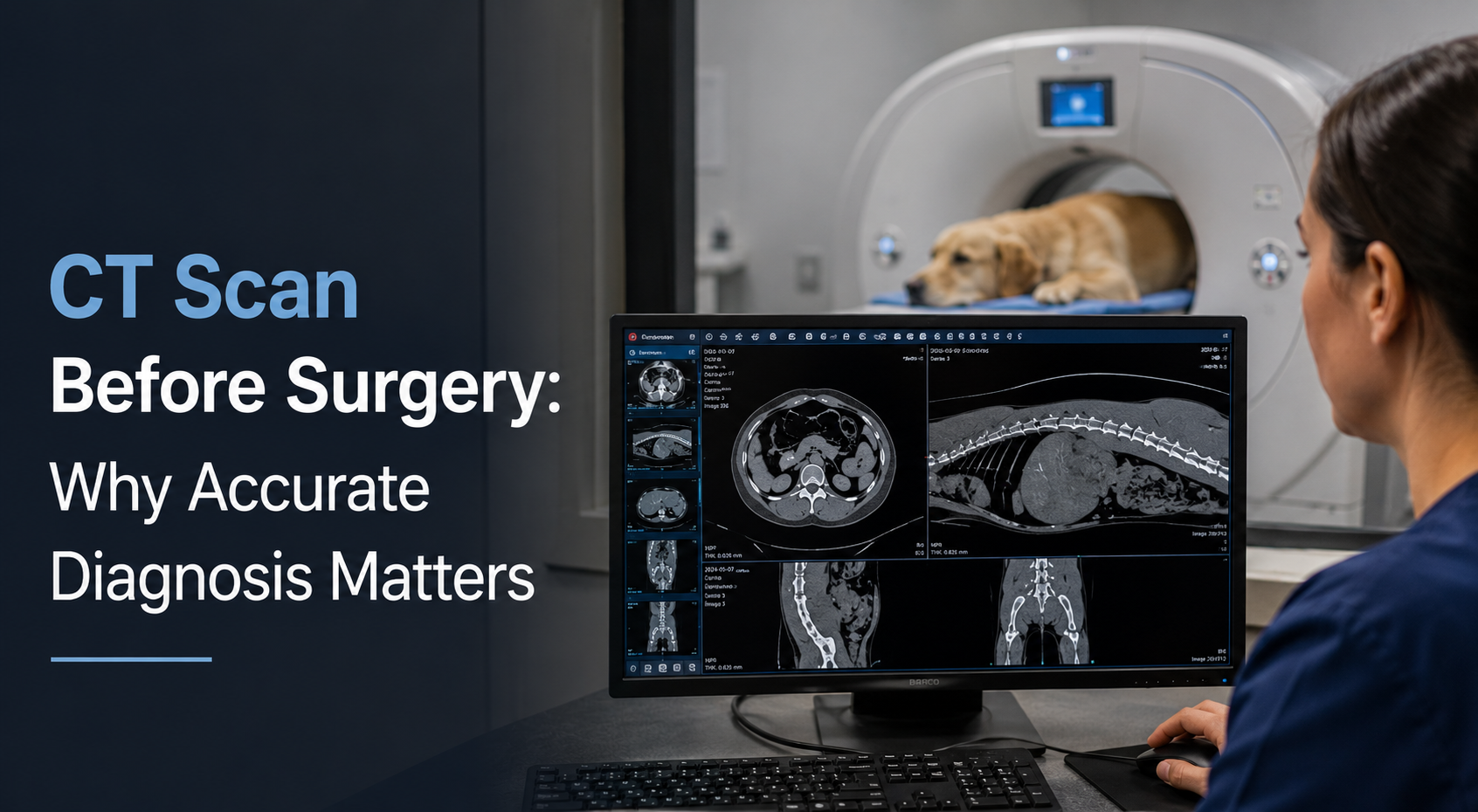
CT Scan Before Surgery: Why Accurate Diagnosis Matters – It is vital to get the right diagnosis when a pet is going to have surgery. CT Scan Before Surgery: Why Accurate Diagnosis Matters is a topic worth discussing in veterinary medicine. CT scans provide highly detailed images of bones, tissues, organs, and blood vessels that may be missed on regular X-rays.
Veterinarians rely on this diagnostic tool not only to help them design the most effective treatment plans but also to minimize the risks of surgery. Whether your pet has a physical injury, a tumor, a nasal problem, or an orthopedic condition, a veterinary CT scan improves surgical precision and supports faster recovery.
What Is a Veterinary CT Scan?
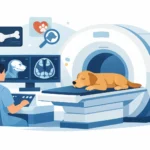
A CT (Computed Tomography) scan is a sophisticated imaging procedure that combines X-rays and computer processing to produce detailed cross-sectional images of a pet’s body. Unlike traditional X-rays, CT scans deliver three-dimensional images that help veterinarians to assess the different layers of the body. Experts in veterinary imaging point out that CT scans are most effective for detecting tumors, fracture diagnosis, lung diseases, identification of spinal disorders, and internal injuries. Veterinary CT scans are commonly used for:
- Preoperative orthopedic surgery
- Finding tumors that are not visible on the surface
- Investigating disorders of the head and nose
- Identifying injuries to the spine
- Evaluating trauma and internal bleeding
- Checking dental and jaw conditions
These detailed images help veterinarians detect problems earlier and more accurately. In fact, the high level of detail of the pictures can practically tell a veterinarian what is wrong and where changes or damage are present in the pet’s body.
Why Accurate Diagnosis Matters Before Surgery
Getting a correct diagnosis is so important because it forms the foundation of successful veterinary surgery. If the imaging is inaccurate, surgeons may not fully understand the extent of the disease, and this can cause more complex situations during surgery.
CT scans help veterinarians:
1. Identify the Exact Problem Area
A CT scan gives a very precise and detailed image of bones, body organs, and different types of tissues. This allows veterinary surgeons to identify both the exact location and severity of the condition before they even start the surgery.
For example, if it turns out that a pet has a tumor, CT scans can also reveal whether cancer has spread to the neighboring connective tissues or body organs. This information helps determine whether surgery is possible and which will be the right way to do it.
2. Improve Surgical Planning
Pre-surgical CT scans help veterinarians develop a more accurate surgical plan. With detailed three-dimensional cross-sectional images available, it becomes easy even for a surgeon to pick the right path so the procedure is more effective in the sense of not doing any more harm to healthy tissues or organs than what is necessary. This is a great help, mostly in:
- Complex orthopedic surgeries
- Brain and spine procedures
- Nasal and sinus surgeries
- Cancers and tumor surgeries
“Advanced imaging technology allows veterinary surgeons to perform procedures with greater precision, reduced tissue damage, and improved outcomes.”
3. Reveal Unexpected Problems
In some cases, traditional X-rays do not reveal everything about a disease or injury. CT scans can show minor irregularities, hidden fractures, or small tumors that may otherwise go undetected.
Spotting these issues early enables vets to plan safer surgeries and prevent surprises during the surgery.
Benefits of CT Scans in Veterinary Surgery
Quick and Precise Diagnosis
The latest CT scanner models produce high-resolution images within minutes. This fast scanning technique is especially useful during veterinary emergencies, and decisions must be made very quickly.
Better Visualization of Complex Anatomy
The skull, the chest, joints, and the spine are some areas that regular X-rays may fail to show properly. CT imaging delivers detailed views of the body slice by slice that help veterinarians make more accurate diagnoses.
Reduced Surgical Risks
With a clearer understanding of the condition, a vet can plan the surgery in such a way that the patient has less time under anesthesia, the surgery is carried out with greater accuracy, and the chances of complications are reduced.
Effective Recovery
A well-planned surgery can lead to:
- Smaller incisions
- Less damage to surrounding tissues
- Less pain
- Faster recovery times for pets
Medical Issues That Commonly Lead to a Surgical CT Scan
A veterinary specialist can order a CT scan for surgery preparation in various health conditions, such as:
Evaluation of Cancer and Tumors
CT scans are very useful for assessing the size of the tumor, the extent of the disease, and the tumor’s relationship to neighboring tissues.
Orthopedic Injuries
Conditions such as fractures, joint diseases, and bone abnormalities will be visible more clearly with the help of CT technology.
Neurological Conditions
Besides helping in the diagnosis of skull or spinal injuries, CT scans can also help identify neurological abnormalities in pets.
Nasal and Dental Disease
CT imaging provides detailed views of the skull and sinuses for pets with bad nasal discharge, facial swelling, or teeth problems.
Emergency Trauma Cases
In veterinary emergencies, CT scans help veterinary teams quickly detect bleeding, fractures, and damage to organs by taking pictures of the inside of the body.
Is a CT Scan Safe for Pets?
Yes, CT scans are considered one of the safest imaging techniques for pets, especially if they are done by skilled veterinary professionals. Since most pets cannot remain still during the scan, they are usually given sedation or anesthesia to keep them comfortable and immobile to ensure accurate imaging. The pets are very closely monitored at all times during the procedure by the veterinary staff to ensure their safety and comfort.
The scan itself is quick, and there is no pain involved.
Conclusion
With the help of advanced imaging technology, veterinarians can detect hidden diseases, improve surgical accuracy, reduce risks, and support faster recovery in pets. AV Veterinary Center offers pet CT scans and other imaging services to support accurate diagnosis and surgical planning. Their commitment to precision imaging helps veterinarians perform safer surgeries and provide better health outcomes for pets.
FAQs
Why is a CT scan performed on my pet before surgery?
It can give a very clear picture of the internal organs and structures of your pet, which can help a vet in deciding what kind of treatment your pet needs and how the surgery would be best done to achieve the best results.
Are CT scans better than X-rays for pets?
While both of these diagnostic techniques have their benefits, owing to their ability to generate detailed, three-dimensional images, CT scans are often more effective, especially when a veterinarian must judge complex conditions with the least amount of error.
Does my pet have to be put under anesthesia for a CT scan?
In general, sedation or anesthesia is given to most pets so that they will remain still throughout the scanning procedure and the resulting images will be very sharp.
How long does a CT scan for pets take?
During the actual scanning, the pet is kept in the machine for only a few minutes, but the total time may be longer if the pet has to be prepared and also after the pet recovers from the effect of the anesthesia or sedation used during the scan.
What diseases or disorders can be found in pets through the use of a CT scan?
Use of CT scanning can bring detection of tumors, identification of fractures, spinal problems, internal injuries, nasal diseases, and a great number of other ailments.